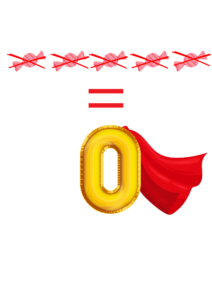
Zero is like a superhero in math. Imagine you have 5 candies, and you eat all of them. How many do you have left? Zero! Without zero, we couldn’t write numbers like 10, 100, or 1,000.
Example: Write the number 105. Without zero, it would just be 15, which is a totally different number!
2. Pi is Endless
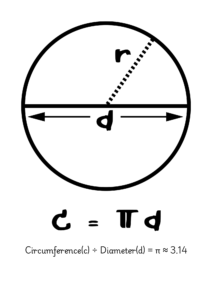
Pi (π) is a special number used to measure circles. It starts as 3.14, but the numbers after the decimal point go on forever without repeating. It’s like a really long number that never stops!
Example: If you draw a circle and measure around it (the circumference), then measure across it (the diameter), dividing the two will give you approximately 3.14. That’s pi!
3. The Fibonacci Sequence
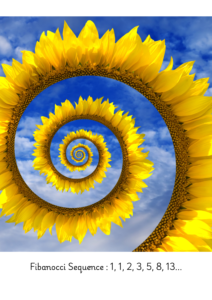
The Fibonacci sequence is a series of numbers where each number is the sum of the two before it. This sequence shows up in nature, like the number of petals on a flower or the way pinecones are arranged.
Example: Start with 1, then add 1 and 1 to get 2, then add 1 and 2 to get 3, then 2 and 3 to get 5, and so on. The sequence is 1, 1, 2, 3, 5, 8, 13…
4. The Oldest Math Problem
Squaring the square is a tricky puzzle where you have to divide a square into smaller squares, all of different sizes. This problem puzzled people for hundreds of years!
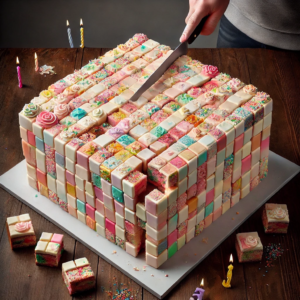
Example: Imagine cutting a big square cake into smaller square pieces, but each piece has to be a different size. It’s hard to do,try your best to figure it out!
5. A Shape with Infinite Sides
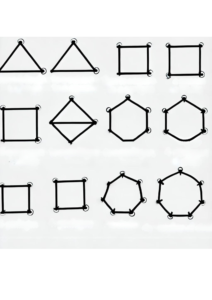
A circle can be thought of as a shape with an infinite number of sides. The more sides a shape has, the closer it looks to a circle.
Example: Draw a triangle. Then, draw a square. Keep adding more sides, like a pentagon (5 sides) and a hexagon (6 sides). If you keep going, it starts to look like a circle!
6. Math in Music
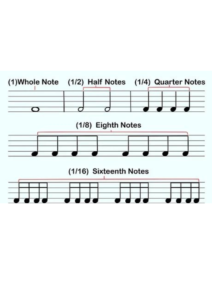
Music and math are like best friends. Notes in music are based on numbers, and rhythms are like fractions. When you clap to a beat, you’re actually doing math!
Example: When you play a note on a piano, the sound has a certain frequency, which is a number. The rhythm in a song can be divided into halves, quarters, and eighths, just like fractions.
7. The Power of Exponents
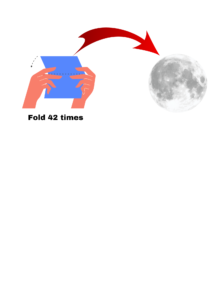
Exponents are a way to multiply a number by itself multiple times. This grows the number very quickly. If you fold a piece of paper, each fold doubles its thickness, and soon it becomes super thick!
Example: Try folding a piece of paper. After just a few folds, it becomes hard to fold again because it gets thick quickly. If you could fold it 42 times, it would reach all the way to the moon!
8. A Triangle with the Most Friends
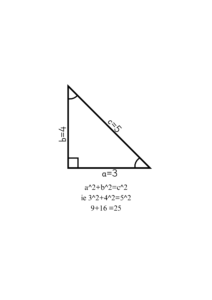
The Pythagorean Theorem is a famous equation that helps you find the length of a side of a right triangle (a triangle with a 90-degree angle).
Example: Imagine a right triangle where one side is 3 units long and the other side is 4 units long. The Pythagorean Theorem tells us that the long side (the hypotenuse) is 5 units long (because 3² + 4² = 9 + 16 = 25, and the square root of 25 is 5).
9. Mathematical Palindromes
Palindromic numbers are numbers that read the same forwards and backwards. They’re fun because they’re like mirror images!
Example: The number 121 is a palindrome because it’s the same whether you read it from left to right or right to left. Another example is 1331.
10. The Golden Ratio
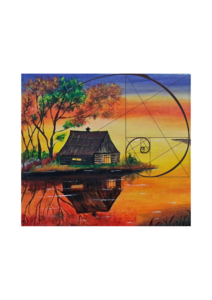
The Golden Ratio is a special number (about 1.618) that is often seen in nature, art, and buildings. Things that have this ratio often look very pleasing to our eyes.
Example: Look at a seashell or a sunflower. The way they grow follows the Golden Ratio. Even famous paintings and buildings often use this ratio because it looks nice!
Priya, a mother of two, understands the value of a strong foundation in Computer Science from an early age. With a keen interest in technology and a passion for researching parenting techniques, she believes that the most effective way for children to retain knowledge is by making learning fun and engaging. Priya, on the other hand, works as a Content Writer at Eduseed, contributing to educational content that supports these goals.