


Harshini
- 05 Nov, 2026
- 0 Comments
- 5 Mins Read
Is Online Math Tutoring Worth It?
An Honest Guide for Parents
Quick answer: Online math tutoring is worth it for most children when the sessions are live, happen at least once or twice a week, and are led by a trained tutor who stays the same over time. Research reviews find tutoring raises maths results by roughly 14 percentile points on average. It is less worth it when it is irregular, mostly recorded videos, or the wrong level for the child.
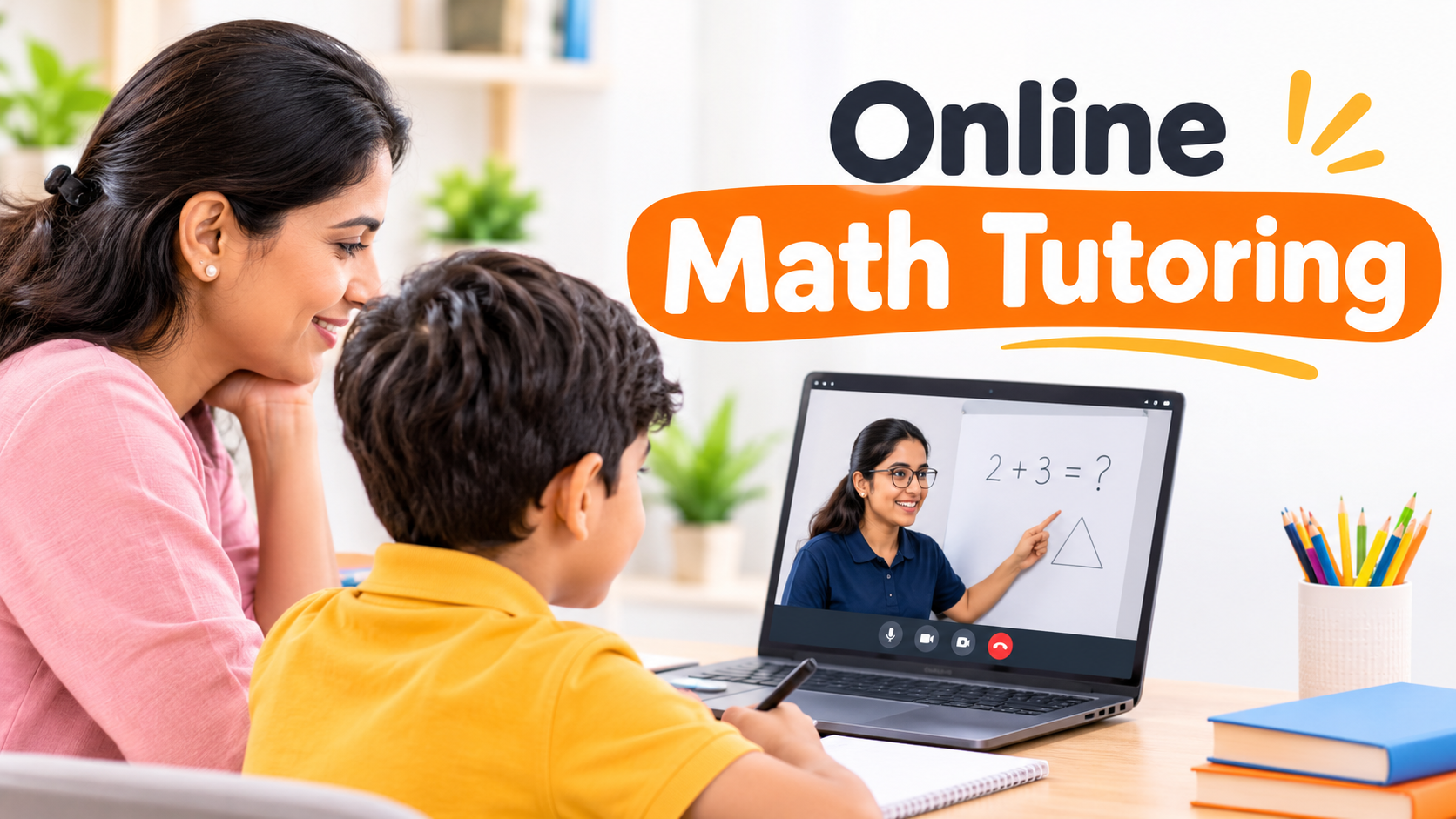
Online math tutoring means a child learns maths from a real tutor over a video call, either alone (1:1) or in a small group. It is different from self-paced maths apps, where a child works through videos and exercises without a live teacher.
What does the research say about math tutoring?
Tutoring is one of the best-studied ways to improve school results, and the evidence is strong but not magical. A typical well-run programme lifts scores by about one-third of a standard deviation.
- A 2020 review of 96 randomised studies by Nickow, Oreopoulos and Quan found an average effect of 0.37 standard deviations, about 14 percentile points. Effects were stronger when tutors were teachers or trained tutors rather than volunteers or parents.
- A study of online tutoring during Italy’s 2020 school closures found that middle-school students given an online tutor improved their academic performance by 0.26 standard deviations, with gains in well-being and confidence too.
- A larger 2024 review of 265 randomised trials by Kraft and colleagues found big average effects (0.42 standard deviations) but smaller effects in very large programmes. Small, well-supervised programmes did better.
- The famous claim that tutoring makes children “two grades better” is exaggerated. Education researchers describe about one-third of a standard deviation as a realistic expectation for good programmes.
The honest takeaway: quality and consistency matter more than the word “tutoring”.
Is online math tutoring as good as in-person tutoring?
For most children aged 7 and above, live online tutoring can work as well as in-person tutoring, as long as the session is interactive. The bigger differences are convenience, tutor choice and how much the child needs physical supervision.
Factor | Live online tutoring | In-person tutoring |
Tutor choice | Any qualified tutor, any city or country | Limited to tutors nearby |
Travel time | None | Travel to and from classes |
Scheduling | Flexible, works across time zones | Fixed by tutor’s location |
Showing working | Digital whiteboard, screen sharing, camera on notebook | Paper and pencil at the same table |
Best for younger children (5–6) | Works with a parent nearby for the first few sessions | Often easier at this age |
Session recordings | Often available for revision | Rarely available |
When is online math tutoring worth the money?
It is most worth it when there is a clear goal and the child is old enough to sit through a focused session. Common situations where parents see real value:
- Your child understands maths in class but forgets it at home, or says “I get it” but can’t solve problems alone.
- Marks are dropping and you can’t tell which topic is the cause.
- Your child finds school maths too easy and is bored.
- You want preparation for competitions such as SOF IMO, Math Kangaroo or Math League.
- You cannot find a good maths tutor nearby, or your schedule doesn’t allow travel.
When is online math tutoring not worth it?
Tutoring rarely helps when the basics of good tutoring are missing. Be cautious if:
- Sessions are irregular, for example once every two weeks or often cancelled.
- The “class” is mostly pre-recorded videos with little live teaching.
- The tutor changes every few weeks, so no one learns how your child thinks.
- The group is large, so your child rarely gets to speak.
- The child is under 6 and no adult can sit nearby during sessions.
- The goal is only to finish homework, rather than to understand the topic.
Is 1:1 or small-group online math tutoring better?
1:1 tutoring gives the most personal attention and is best for filling gaps fast. Small groups of 2–4 children cost less per child and add some healthy peer discussion. Large groups behave more like a regular class.
Format | Best for | Watch out for |
1:1 | Gaps, exam prep, shy children, very fast or slow learners | Higher cost per session |
Small group (2–4) | Steady progress, children who enjoy discussion, olympiad practice | Group must be at a similar level |
How do I choose a good online math tutor? A 7-point checklist
Ask these questions before you pay for a full course:
- Is it live? Make sure your child is taught in real time, not by recorded lessons.
- How many children per class? 1:1 or small groups of 2–4 give the most feedback.
- How often? Two sessions a week is a common and effective rhythm.
- Will the tutor stay the same? Continuity helps the tutor understand your child.
- Does it teach concepts or only tricks? Ask the tutor to explain why a method works during the demo.
- How is progress shown? Look for regular updates, tests or reports to parents.
- Is there a free trial? A demo class shows you the teaching style before you commit.
How long before I see results from online math tutoring?
Most parents notice a change in confidence within a few weeks, and in test marks after 8 to 12 weeks of regular sessions. Give it one full school term before deciding.
Signs it is working:
- Your child explains a method in their own words.
- Homework takes less time and fewer tears.
- Fewer repeat mistakes on the same topic.
- School test marks improve on topics covered in tutoring.
Where does Eduseed fit?
Eduseed has taught live online maths and coding to children aged 6–16 (Grades 1–8) since 2021, with 700+ students across many countries and 35,000+ hours of live sessions.
- Live, instructor-led classes, 1:1 or small groups of 2–4 students.
- 60-minute sessions, typically twice a week, with flexible timing for different time zones.
- An in-house Grade 1–8 curriculum that builds understanding of concepts, not just answer-getting.
- Olympiad tracks for SOF IMO, Math Kangaroo and Math League.
- A free demo class before you decide.
Eduseed is a strong fit if you want a consistent live tutor and conceptual depth, or olympiad preparation. If your child only needs occasional homework help, a self-paced practice app may be enough and cost less.
Frequently Asked Questions
Is online math tutoring effective for kids?
Yes, when it is live, regular and led by a trained tutor. Research reviews show tutoring raises maths results by about one-third of a standard deviation on average, and an online-only programme in Italy showed similar gains.
What age is best to start online math tutoring?
Most children can learn well online from about age 6 or 7. Younger children usually need a parent close by during the first few sessions.
How many math tutoring sessions per week are needed?
Two sessions a week is a common and effective schedule. It is frequent enough to build on each lesson without overloading the child.
Is online math tutoring better than math apps?
They do different jobs. Apps are good for extra practice, while a live tutor can find why a child is making mistakes and explain it in a new way.
Is 1:1 math tutoring worth the extra cost?
1:1 is worth it when your child has clear gaps, is preparing for an exam, or needs more attention. For steady progress, a small group of 2–4 children often gives similar benefits at a lower cost.
Can online tutoring help with math olympiads?
Yes. Olympiads such as SOF IMO and Math Kangaroo test reasoning beyond the school syllabus, and a tutor can teach the problem-solving strategies and review timed mock papers.
Online math tutoring is worth it when it is live, regular, with a consistent tutor and a clear goal. Research supports real gains, but not overnight miracles; give it a full term. Use the 7-point checklist and a free trial to choose. If you’d like to see what a live session looks like, book a free Eduseed demo class.