


Priya Gunasekaran
- 09 Sep, 2025
- 0 Comments
- 4 Mins Read
Lighthouse Parenting Style: Guiding Kids Like Coders of Their Own Lives
Parenting today feels a lot like programming.
– Every child is like a unique codebase—full of potential, but requiring debugging, testing, and patience.
– Parents act like developers and mentors, shaping not just what the child does today, but how they’ll “run” in the future.
– And just like in coding, there’s no single right way—there are styles, philosophies, and frameworks.
One of the most powerful frameworks emerging in recent years is the Lighthouse Parenting Style. Unlike helicopter parenting (overprotective) or free-range parenting (hands-off), lighthouse parenting is about guidance, presence, and trust—helping kids grow into independent, resilient problem-solvers.
The Lighthouse Metaphor
Imagine your child as a ship sailing through stormy seas.
– If you try to control the wheel for them (helicopter style), they’ll never learn how to navigate.
– If you leave them entirely alone (free-range style), they might crash into rocks they never saw coming.
– But if you’re a lighthouse, you:
> Stand tall and steady.
> Shine a light to guide the way.
> Offer safety, but don’t steer the ship for them.
In coding terms:
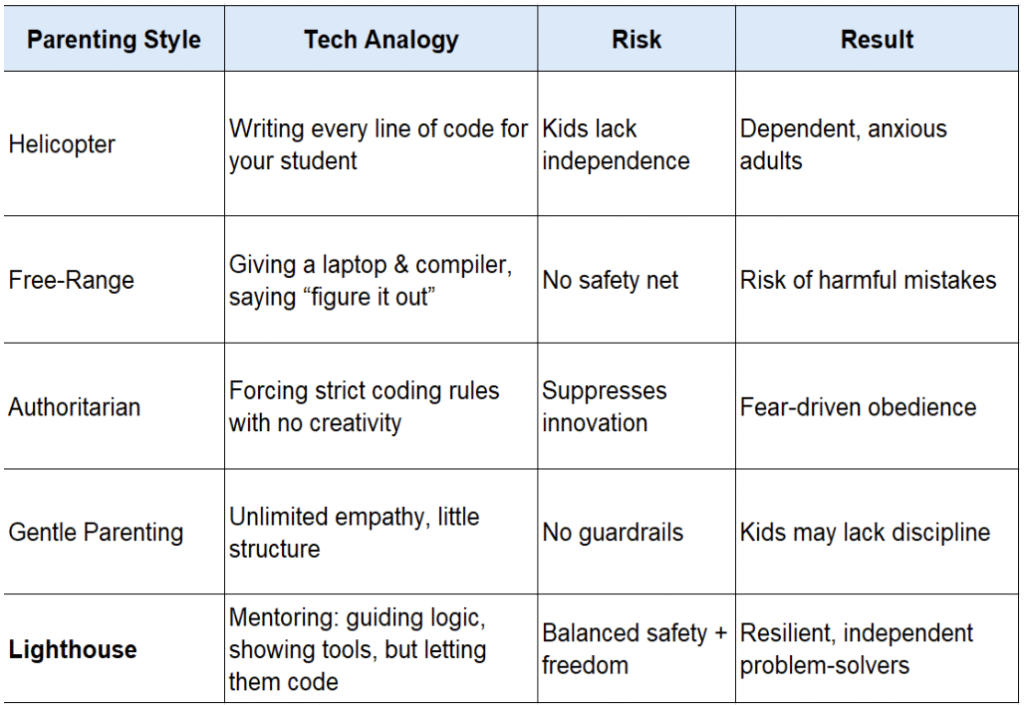
– A helicopter parent is like writing all the code for your student.
– A free-range parent is like saying: “Here’s a compiler, good luck!”
– A lighthouse parent is like a mentor who teaches logic, provides debugging tools, and watches from the sidelines—stepping in only when truly needed.
Principles of Lighthouse Parenting
1. Guidance Without Micromanaging
Parents provide boundaries, values, and moral direction. Children get freedom to make choices within those boundaries. Just like in coding: instead of typing every line for a student, you teach them loops, conditionals, and logic, so they can build their own program.
2. Safe Space for Risk-Taking
Children learn best when they experiment. Risk is not the enemy—it’s part of growth. Lighthouse parents allow “controlled risk”: falling off a bike, failing a test, or messing up a project. In coding it’s like trying new libraries, breaking code, debugging for hours—these “failures” become the path to mastery.
3. Strong Emotional Connection
Lighthouse parenting emphasizes being present, empathetic, and approachable. Kids know they can talk without fear of punishment or judgment. In coding: imagine an instructor who doesn’t scold for syntax errors but says, “Good, you’re learning how to debug.” That’s the emotional connection children need.
4. Building Resilience & Problem-Solving
Life is full of bugs with emotional, social, academic. Instead of shielding children from challenges, lighthouse parents teach them coping strategies. Every failure becomes a unit test for resilience. In tech: a coder who never faces errors can’t handle real-world projects. Similarly, a child who never struggles won’t thrive in adulthood.
5. Modeling Behavior
Parents serve as role models: how they handle stress, failure, or conflict is silently copied by children. Think of it like clean coding practices—if you always write messy, unstructured code, your students will too. If you demonstrate thoughtful problem-solving, kids will inherit it.
Comparing Parenting Styles
Why Lighthouse Parenting Matters in 2025
Today’s world is more complex than ever:
– AI, automation, and rapid tech shifts mean kids must constantly adapt.
– Mental health challenges are rising among children and teens.
– Over-sheltering leads to anxiety, while over-freedom leads to disconnection.
Lighthouse parenting prepares children for this reality:
– They grow up self-reliant but emotionally connected.
– They know how to debug life’s problems without collapsing.
– They’re future-ready: capable of learning new skills, adapting, and thriving.
Practical Ways to Be a Lighthouse Parent
1. Set Clear Boundaries
Like defining coding rules: indentation, variable naming, and testing. Kids thrive with structure but within it, let them be creative.
2. Encourage Failure as Feedback
Celebrate mistakes as learning opportunities. In coding: a red error message isn’t failure, it’s feedback.
3. Listen Before Lecturing
When kids share problems, don’t jump in with solutions. Ask guiding questions: “What do you think would happen if…?”
4. Teach Coping & Problem-Solving
Help kids brainstorm multiple solutions. Like debugging: try different fixes until one works.
5. Stay Consistent & Visible
Be present, like a steady light. Kids should always know: “My parents are there for me, even if they’re not steering.”
Just as coding isn’t about writing perfect programs on the first try, parenting isn’t about raising “error-free” kids. It’s about teaching them how to handle errors, debug life, and keep learning.
The Lighthouse Parenting Style does exactly that:
- Parents are anchors of safety, not pilots of the ship.
- They guide without controlling, protect without suffocating, and love without conditions.
In both coding and parenting, the ultimate goal is the same:
To build confident, independent problem-solvers who can thrive in a complex world.
At eduSeed, we see this every day. The best students aren’t the ones spoon-fed answers, they’re the ones guided with patience, trust, and encouragement. That’s the essence of Lighthouse Parenting: raising kids who don’t just survive life’s bugs, but thrive by fixing them.

Priya Gunasekaran
Priya, a mother of two, understands the value of a strong foundation in Computer Science from an early age. With a keen interest in technology and a passion for researching parenting techniques, she believes that the most effective way for children to retain knowledge is by making learning fun and engaging. Priya, on the other hand, works as a Content Writer at Eduseed, contributing to educational content that supports these goals.