


Harshini
- 13 Nov, 2026
- 0 Comments
- 6 Mins Read
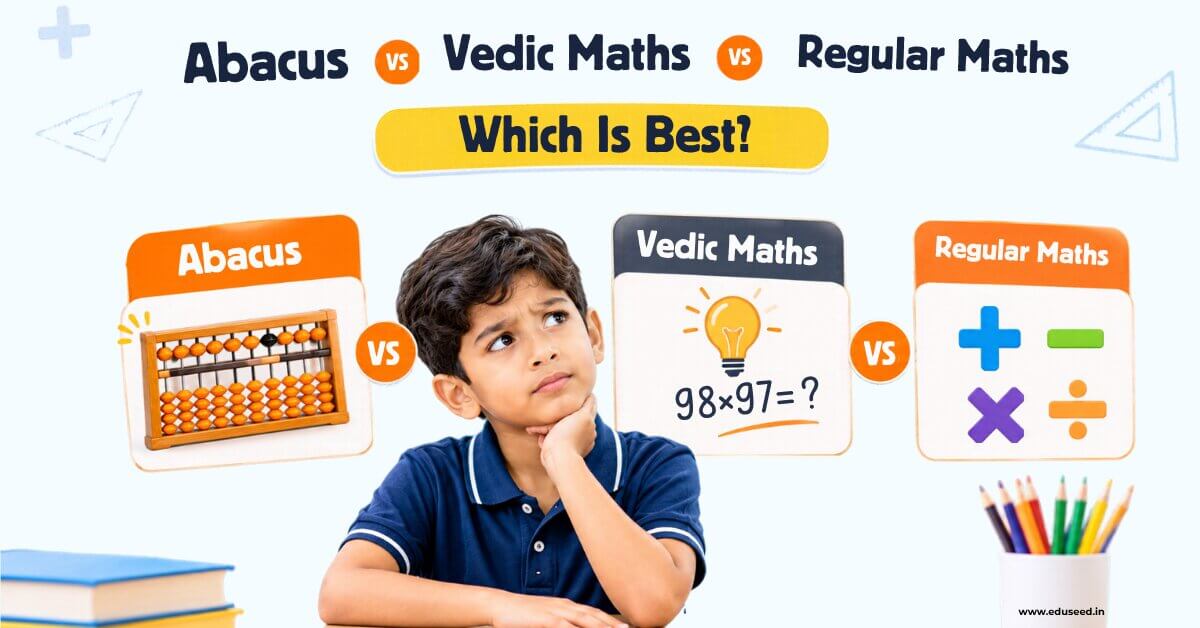
Abacus vs Vedic Maths vs Regular Maths
Which Is Best for Your Child?
Quick answer: In the abacus vs Vedic Maths debate, neither one replaces regular maths. Abacus builds fast mental arithmetic and suits ages 5–8. Vedic Maths teaches calculation shortcuts and is most useful from about Class 5. Regular maths builds the understanding that school exams and olympiads test. Most children do best with strong regular maths first, and abacus or Vedic Maths as an add-on.
All three are ways of learning maths, but they do very different jobs. Abacus and Vedic Maths mainly make calculation faster. Regular maths teaches what numbers mean and how to solve problems with them.
What is abacus maths?
Abacus maths teaches children to calculate using a frame of sliding beads, and later to picture that frame in their head. The second stage is called mental abacus.
- Each column of beads stands for a place value: ones, tens, hundreds and so on.
- Children first add and subtract by moving real beads.
- With practice, they “move” imaginary beads and can add long lists of numbers very quickly.
- Classes usually run in levels, often over two to three years.
What is Vedic Maths?
Vedic Maths is a set of mental calculation shortcuts based on 16 short rules called sutras. They were compiled by Bharati Krishna Tirtha, and his book Vedic Mathematics was published in 1965.
The tricks are valid arithmetic and can be genuinely fast. Two examples:
- 98 × 97: Both numbers are close to 100. They are 2 and 3 short. Subtract across (98 − 3 = 95) and multiply the shortfalls (2 × 3 = 06). Answer: 9506.
- 35²: For a number ending in 5, multiply the first digit by the next number (3 × 4 = 12) and write 25 after it. Answer: 1225.
One honest note for parents: historians and mathematicians have pointed out that these sutras are not found in the known texts of the Vedas. That doesn’t make the methods wrong. It simply means Vedic Maths is a 20th-century system of shortcuts, not an ancient alternative to school maths.
What is regular maths?
Regular maths is the school curriculum, such as CBSE, ICSE, state boards, or the national curriculum in other countries. It covers number sense, place value, fractions, geometry, measurement, data, early algebra and word problems.
Its focus is understanding why methods work and choosing the right method for a new problem. This is what school tests, board exams and olympiads such as SOF IMO and Math Kangaroo actually check.
Abacus vs Vedic Maths: what is the difference?
Abacus trains a visual way of calculating with imagined beads. Vedic Maths teaches number patterns and shortcuts on paper or in the head. Regular maths teaches concepts and problem solving. The table compares all three side by side.
Abacus | Vedic Maths | Regular maths | |
What it teaches | Fast addition, subtraction, multiplication with a (mental) bead frame | Shortcuts for multiplying, squaring, dividing and checking answers | Concepts, reasoning and problem solving across all topics |
Usual starting age | 5–8 years | About 10 years and up (Class 5+) | From Class 1 |
Main strength | Speed and accuracy in arithmetic; strong place-value sense | Faster calculation for older students; useful for competitive exams | Understanding that transfers to new problems |
Main limit | Covers mostly arithmetic, not geometry, fractions or word problems | Only helps with certain number types; tricks without understanding fade | Can feel slow if taught as rote drills |
Helps with school exams? | Partly (calculation sections) | Partly (calculation speed) | Yes, directly |
Helps with olympiads? | A little (speed) | A little (speed, checking) | Yes; olympiads test reasoning |
Time commitment | Usually several levels over 2–3 years | Can be learned in weeks to months | Ongoing through school |
What does the research say about abacus and Vedic Maths?
Abacus has some good evidence for arithmetic gains, but not for wider “brain” benefits. Vedic Maths has very little rigorous research behind it.
- A three-year randomised trial with about 180 children aged 5–7 in Vadodara, Gujarat compared mental abacus training with the same amount of extra regular maths. The abacus group did better at arithmetic. However, it did not improve basic thinking skills such as working memory.
- In the same study, children who started with stronger visual memory gained the most. Abacus did not suit every child equally.
- A later one-year classroom trial by the same research team found that first-graders struggled to master the abacus, while second-graders did better. The authors advised caution about using abacus as a quick fix.
- We could not find large randomised studies of Vedic Maths for school children. Its benefits are mostly reported by teachers and students rather than measured in controlled trials.
Which is best for my child?
The right choice depends on your child’s age and what you want to fix. Use this as a guide:
If your child is… | Best choice | Why |
5–7 years old and enjoys hands-on activities | Regular maths, with abacus as an optional add-on | Abacus builds number sense and speed at the age it is easiest to learn |
Struggling with school maths at any age | Regular maths with a good tutor | Speed tricks don’t fix gaps in understanding |
Class 5–8 and slow at calculation | Regular maths plus a short Vedic Maths course | Shortcuts save time once the concepts are clear |
Preparing for SOF IMO, Math Kangaroo or Math League | Regular maths with olympiad-level problem solving | Olympiads test reasoning, not only speed |
Already strong at maths and wants a challenge | Olympiad prep or deeper problem solving | More stretch than extra calculation drills |
A simple rule: if your child gets answers wrong, focus on regular maths. If they get answers right but slowly, abacus (younger children) or Vedic Maths (older children) can help.
Common myths about abacus and Vedic Maths
Some popular claims go further than the evidence. Here is what parents should know:
- “Abacus increases IQ or develops the whole brain.” The best randomised study found arithmetic gains but no change in basic thinking skills such as working memory.
- “Vedic Maths can replace school maths.” It covers calculation shortcuts, not topics like geometry, data or word problems.
- “Faster calculation means better at maths.” Speed helps, but school exams and olympiads mostly test understanding and reasoning.
- “Abacus confuses children in school.” Usually not, but some children need help connecting bead methods to written methods taught in class.
Can my child learn abacus or Vedic Maths alongside school maths?
Yes, and that is usually the best way to use them. Treat abacus or Vedic Maths as a speed skill on top of regular maths, not a replacement for it.
- Keep regular maths as the main subject, especially if marks are average or falling.
- Add abacus at ages 5–8 only if your child enjoys it and has time without feeling overloaded.
- Add Vedic Maths later, around Class 5 or above, once multiplication tables and place value are secure.
- Ask the tutor to explain why each shortcut works. A trick that is understood lasts; a trick that is only memorised is soon forgotten.
Where does Eduseed fit?
Eduseed focuses on regular maths taught for understanding, plus olympiad preparation. It is not an abacus or Vedic Maths centre.
Since 2021, Eduseed has taught live online maths and coding to children aged 6–16 (Grades 1–8), with 700+ students across many countries and 35,000+ hours of live sessions.
- Live, instructor-led classes, 1:1 or small groups of 2–4 students.
- 60-minute sessions, typically twice a week, with flexible timing for different time zones.
- An in-house Grade 1–8 maths curriculum that builds concepts, not just answer-getting.
- Olympiad tracks for SOF IMO, Math Kangaroo and Math League.
- A free demo class before you decide.
eduSeed is a good fit if your child needs stronger understanding, better school marks or olympiad preparation. If you mainly want calculation speed for a young child, a dedicated abacus class is the more direct choice.
Frequently Asked Questions
Which is better, abacus or Vedic Maths?
Neither is better overall; they suit different ages. Abacus works best for children aged 5–8, while Vedic Maths suits children from about Class 5 who already know their tables.
What is the right age to learn abacus?
Most abacus programmes start between ages 5 and 8. Research suggests very young first-graders can find it hard, so wait until your child counts and recognises numbers confidently.
Is abacus good for kids?
Abacus can improve arithmetic speed and place-value understanding, according to a three-year randomised study in India. It does not appear to boost general brain skills such as memory.
Is Vedic Maths useful for school exams?
It can save time on calculation-heavy questions. It does not teach the concepts, word problems or reasoning that make up most of a school maths paper.
Does abacus or Vedic Maths help with Math Olympiads?
Only a little. Olympiads such as SOF IMO and Math Kangaroo reward reasoning and problem solving more than calculation speed.
Can a child learn both abacus and Vedic Maths?
Yes, but not usually at the same time. A common path is abacus in the early years and Vedic Maths shortcuts later, always alongside regular maths.
In the abacus vs Vedic Maths vs regular maths question, regular maths taught for understanding comes first for every child. Abacus is a good speed add-on for children aged 5–8, and Vedic Maths is a useful shortcut toolkit from about Class 5. Choose based on your child’s age and the problem you want to solve. If your child needs stronger understanding or olympiad preparation, book a free Eduseed demo class.