


Priya Gunasekaran
- 10 Jan, 2026
- 0 Comments
- 3 Mins Read
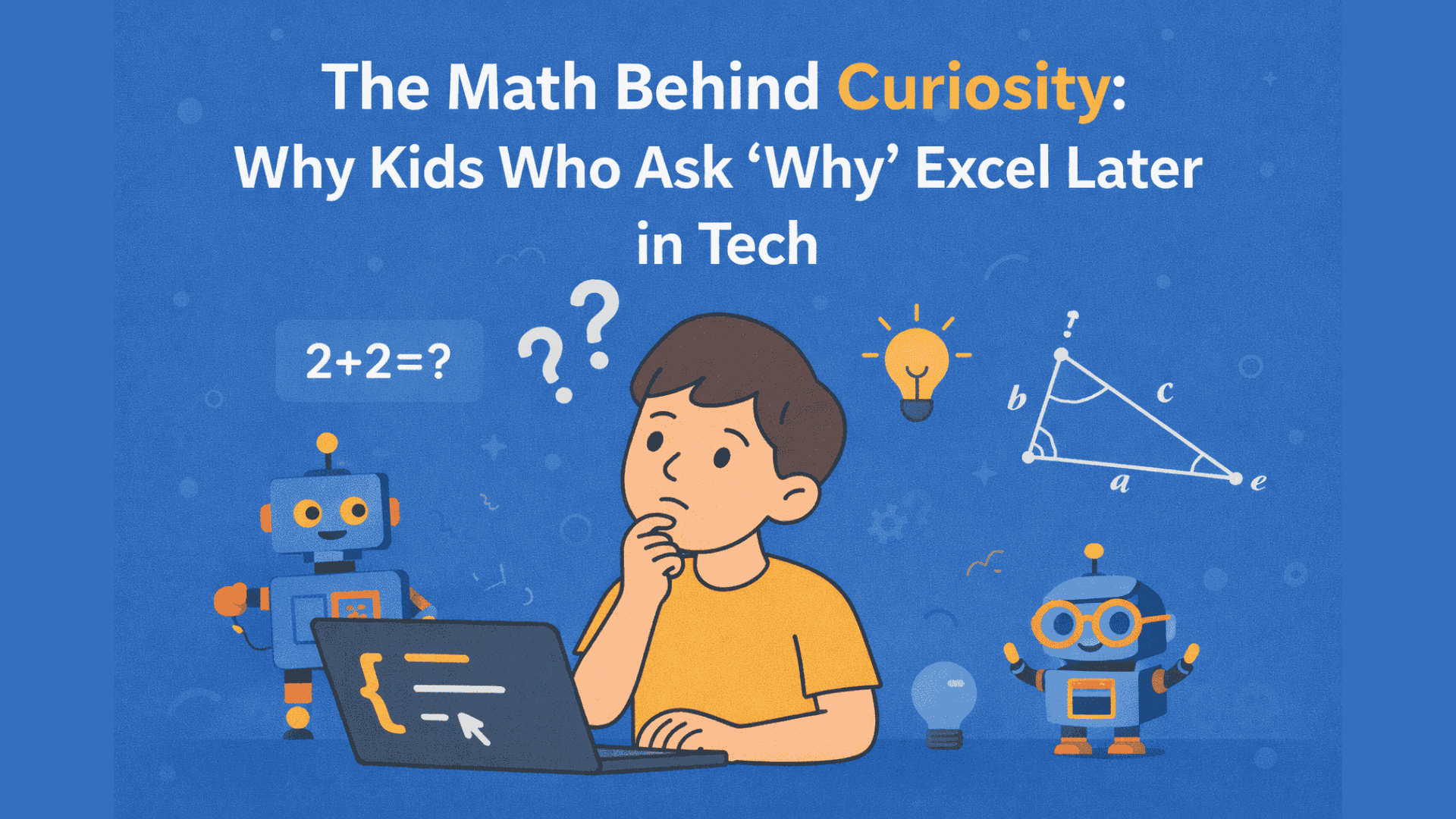
The Math Behind Curiosity: Why Kids Who Ask “Why” Excel Later in Tech
“Why does this work?”
“Why can’t we do it another way?”
“Why does the computer behave like that?”
If your child asks too many questions, you’re not alone and here’s the good news:
That curiosity is one of the strongest predictors of future success in math, coding, and technology.
At eduSeed, we see it every day. The kids who ask why don’t just learn faster they learn deeper.
Curiosity Is the Real Superpower (Not Just Talent)
Many parents believe that success in math or coding comes from being naturally smart.
But research and real classroom experience tells a different story.
The most successful learners in STEM are not the ones who memorize fastest.
They’re the ones who question, explore, and experiment.
When a child asks why, their brain is doing something powerful:
– Connecting new ideas to existing knowledge
– Searching for patterns
– Testing assumptions
– Building logical frameworks
That’s not just curiosity, that’s mathematical thinking in action.
The Hidden Math Inside “Why”
Let’s imagine two children learning a math concept.
– Child A memorizes a formula and moves on.
– Child B asks, “Why does this formula work?”
Child B might take longer at first — but something important is happening:
They’re learning how math works, not just what math says.
This kind of thinking:
– Strengthens reasoning and logic
– Improves problem-solving skills
– Builds confidence to tackle unfamiliar problems
And these are the exact same skills needed for coding, data science, AI, and engineering.
Why Curious Kids Thrive in Coding
Coding is not about typing lines of code.
It’s about asking questions constantly:
– Why did this error occur?
– Why doesn’t the program behave as expected?
– Why does changing this variable affect the outcome?
In fact, debugging (fixing errors) is essentially a structured form of curiosity.
Curious kids:
– Explore multiple solutions instead of stopping at one
– Aren’t afraid of mistakes — they see them as clues
– Enjoy experimentation and iteration
That’s why kids who ask “why” often become:
– Strong coders
– Creative problem solvers
– Confident innovators
A Small Story from eduSeed
One of our students once asked during a coding class,
“Why can’t the computer understand what I mean?”
Instead of giving a quick answer, we turned it into a discussion:
– How computers think
– Why logic must be precise
– How humans and machines communicate differently
That single “why” sparked a deeper understanding not just of coding, but of logical thinking itself.
Today, our students don’t just write code, they design solutions.
What Parents Can Do: Encourage the “Why”
Sometimes, curiosity can feel exhausting:
“Why so many questions?”
“Just follow the steps!”
But every why is an opportunity.
Here’s how parents can support curious learners:
– Celebrate questions instead of rushing answers
– Ask “What do you think?” back
– Encourage exploration, not perfection
– Choose learning environments that value thinking over memorization
How eduSeed Turns Curiosity into Capability
At eduSeed, we don’t teach kids what to think, we teach them how to think.
Our math and coding programs are designed to:
– Encourage questioning and exploration
– Connect math concepts to real-world logic
– Use coding as a tool for creative problem-solving
– Build confidence through experimentation and discovery
We believe curiosity is not a distraction, it’s the foundation of innovation.
The Future Belongs to the Curious
In a world driven by technology, answers change fast.
But the ability to ask the right questions lasts forever.
So the next time your child asks “Why?”, smile
because you might be raising a future engineer, coder, or innovator.
And at eduSeed, we’re here to help that curiosity grow into skill, confidence, and success.

Priya Gunasekaran
Priya, a mother of two, understands the value of a strong foundation in Computer Science from an early age. With a keen interest in technology and a passion for researching parenting techniques, she believes that the most effective way for children to retain knowledge is by making learning fun and engaging. Priya, on the other hand, works as a Content Writer at Eduseed, contributing to educational content that supports these goals.