


Priya Gunasekaran
- 16 Mar, 2026
- 0 Comments
- 3 Mins Read
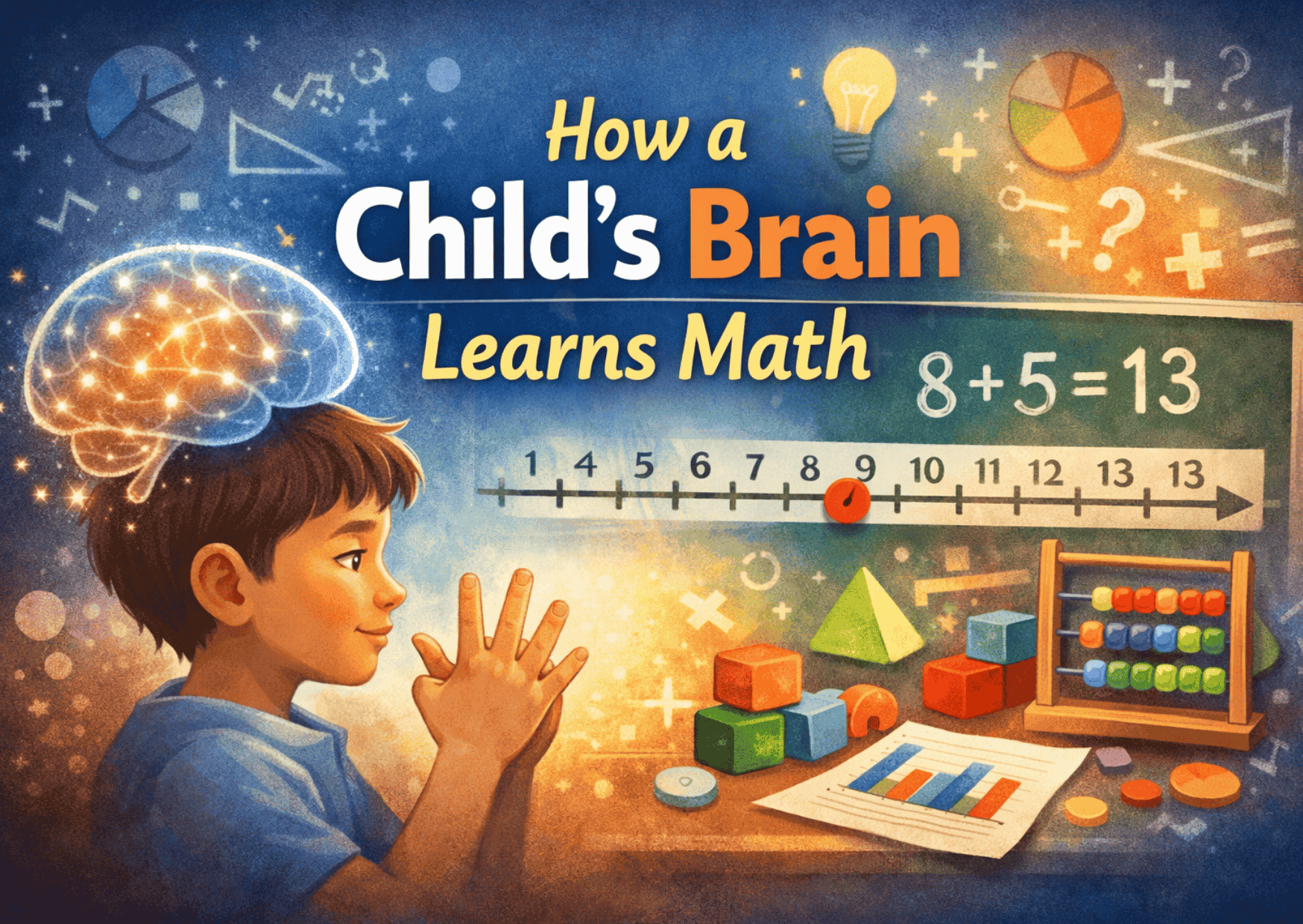
How a Child’s Brain Learns Math: A Story Happening Inside the Mind
One evening, a five-year-old named Aarav sat at the dining table staring at three cookies on a plate.
His mother asked, “If I give you two more cookies, how many will you have?”
Aarav paused. He looked at the cookies, then at his fingers. Slowly, he raised three fingers… then two more. After a moment of serious thinking, his face lit up.
“Five!”
To an adult, this looks like a simple moment. But inside Aarav’s brain, something extraordinary just happened.
Thousands of neurons fired together, building new connections that will shape how he understands numbers for the rest of his life.
This is how a child’s brain begins its journey into math.
The Brain That Sees Numbers Before Words
Long before children learn to write “1, 2, 3,” their brains already sense quantities.
Imagine showing a baby two toys… and then suddenly placing three toys in front of them. Many babies stare longer, as if something has changed. They cannot say the number, but their brain detects the difference.
Scientists call this number sense an intuitive ability to recognize “more” and “less.”
It is the brain’s earliest math skill.
Like the roots of a tree hidden underground, this sense quietly supports everything that comes later: counting, addition, multiplication, and even algebra.

Fingers: The First Calculator
Back at the table, Aarav used his fingers to solve the cookie problem.
Some adults worry that finger counting slows children down. But in reality, fingers are one of the brain’s best learning tools.
When a child counts on their fingers, several brain systems work together:
– Visual areas see the fingers
– Motor areas move them
– Number-processing areas track the quantities
The brain is not just memorizing numbers—it is experiencing them.
In a way, fingers turn abstract math into something a child can see and touch.
The Moment of Confusion
The next day in school, Aarav faces a new problem:
8 + 5
He tries counting, pauses, and frowns.
For a moment, his brain struggles.
But here’s the fascinating part: this struggle is exactly where learning happens.
When children attempt a difficult problem, the brain’s problem-solving networks become active. Neurons communicate intensely, trying different paths to reach an answer.
Even mistakes help.
In fact, studies show the brain forms stronger connections after correcting an error than after simply memorizing the right answer.
So every “wrong answer” is actually part of the brain’s construction process.
Why Pictures Make Math Click
A teacher draws a number line on the board.
Instead of memorizing that 8 + 5 equals 13, Aarav imagines standing on the number 8 and taking five steps forward.
9… 10… 11… 12… 13.
Suddenly the answer makes sense.
Children’s brains love visual thinking. Blocks, drawings, diagrams, and number lines help translate abstract numbers into clear mental images.
This is why many children understand math better when they can see it instead of just hearing it.
When Feelings Enter the Equation
Now imagine two different classrooms.
In one classroom, math is stressful. Mistakes are embarrassing, and children fear getting answers wrong.
In the other classroom, math feels like a puzzle. Students explore patterns, ask questions, and even laugh at mistakes.
The difference is not just emotional—it is neurological.
When children feel anxious, the brain’s stress system interferes with learning. But when they feel curious and safe, the brain releases dopamine, a chemical that boosts motivation and memory.
In other words, the brain learns math best when it feels safe to explore.
Growing a Math Brain
Many people believe some children are simply “math people.”
But neuroscience tells a different story.
The brain is constantly changing. Each time a child counts toys, divides snacks with friends, builds patterns with blocks, or solves puzzles, new neural pathways grow stronger.
Math ability is not a fixed talent.
It is a skill that develops through experience, curiosity, and practice.
The Quiet Magic of Learning
Later that evening, Aarav is back at the dining table.
This time there are four cookies.
His sister takes one.
“How many are left?” his father asks.
Aarav doesn’t need his fingers now.
“Three,” he says confidently.
It seems like a small moment.
But inside his brain, a complex network of connections has just grown stronger.
Because every time a child learns math, they are not just learning numbers.
They are learning how to think.

Priya Gunasekaran
Priya, a mother of two, understands the value of a strong foundation in Computer Science from an early age. With a keen interest in technology and a passion for researching parenting techniques, she believes that the most effective way for children to retain knowledge is by making learning fun and engaging. Priya, on the other hand, works as a Content Writer at Eduseed, contributing to educational content that supports these goals.