


Priya Gunasekaran
- 10 Jun, 2026
- 0 Comments
- 4 Mins Read
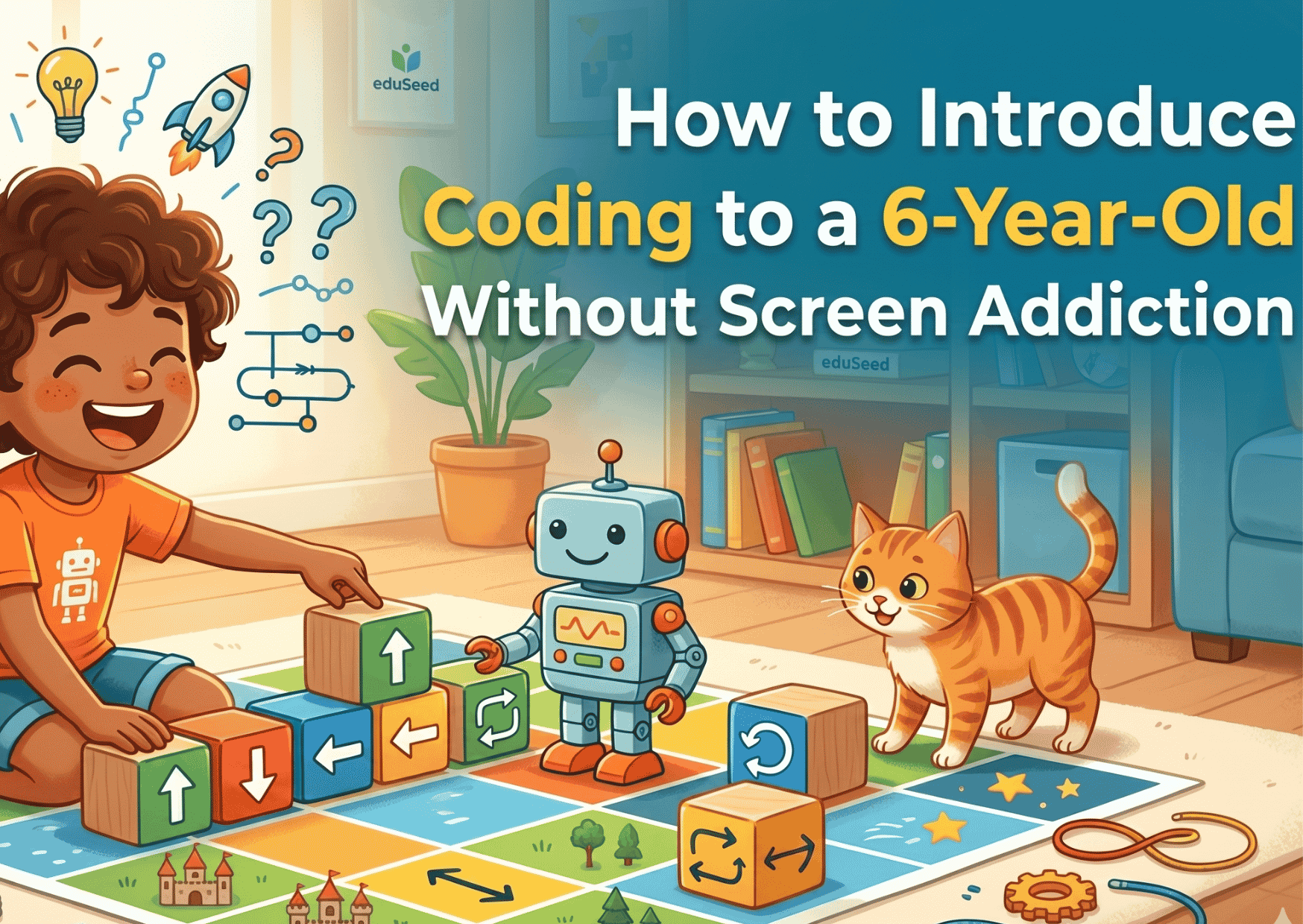
How to Introduce Coding to a 6-Year-Old Without Screen Addiction
When parents hear the word coding, they often imagine children glued to screens for hours. But here’s the surprising truth:
Good coding education for young children is actually less about screens and more about thinking.
At age 6, kids don’t need complicated programming languages or endless online classes. What they really need is:
– curiosity,
– creativity,
– problem-solving,
– and playful learning.
The goal isn’t to turn your child into a software engineer overnight.
The goal is to help them learn how to think.
And yes — it’s absolutely possible to introduce coding without creating screen addiction.
Why Coding Is Valuable for Young Children
Coding teaches much more than technology. When children learn coding concepts early, they develop:
– logical thinking,
– pattern recognition,
– patience,
– creativity,
– and confidence in solving problems.
In fact, coding for young kids is similar to learning a new language — except this language teaches them how systems work.
At age 6, children are naturally curious:
“What happens if I press this?”
“Why did this move?”
“Can I make my own game?”
Coding channels that curiosity into structured thinking.
The Biggest Mistake Parents Make
Many parents think:
“The earlier my child starts coding on a laptop, the better.”
Not true.
Young children should not begin with long screen sessions or complex software.
Too much passive screen time can:
– reduce attention span,
– impact sleep,
– and create dependency on instant entertainment.
The solution is simple:
Introduce coding as an activity, not as screen entertainment.
Coding should feel like:
– solving puzzles,
– building stories,
– giving instructions,
– and creating things.
Not mindless scrolling.
Start With “Unplugged Coding”
Before using a computer, teach coding concepts through everyday activities.
This is called unplugged coding — learning programming logic without screens.
Children can learn:
– sequencing,
– patterns,
– algorithms,
– and debugging…
…using games, toys, and movement.
5 Fun Screen-Free Coding Activities for 6-Year-Olds
1. Give Robot Instructions
Pretend you are a robot.
Ask your child to guide you:
– “Take 3 steps forward”
– “Turn left”
– “Pick up the book”
When instructions are unclear, intentionally make mistakes.
Kids quickly learn:
– coding requires precision,
– order matters,
– and mistakes can be fixed.
That’s real programming logic.
2. Create Treasure Hunt Algorithms
Hide a toy somewhere in the house.
Ask your child to write step-by-step instructions:
1. Walk to the sofa
2. Turn right
3. Open the drawer
This teaches:
– sequencing,
– logical flow,
– and problem-solving.
3. Use Building Blocks and Patterns
LEGO, magnetic tiles, or blocks are fantastic coding tools.
Ask questions like:
– “What comes next?”
– “Can you repeat this pattern?”
– “Can you build this using only 5 blocks?”
Coding is deeply connected to pattern recognition.
4. Play Board Games
Games like:
– Chess,
– Uno,
– Sequence,
– Rush Hour,
– and puzzles…
…help children develop strategic thinking.
Coding starts with thinking ahead.
5. Encourage Story Creation
Ask your child to invent interactive stories:
“If the dragon wakes up, what happens next?”
This introduces:
– conditions (“if/then” logic),
– sequencing,
– and creativity.
Exactly how programming works
When Should Kids Start Using Screens for Coding?
Screens are not the enemy.
The key is intentional use.
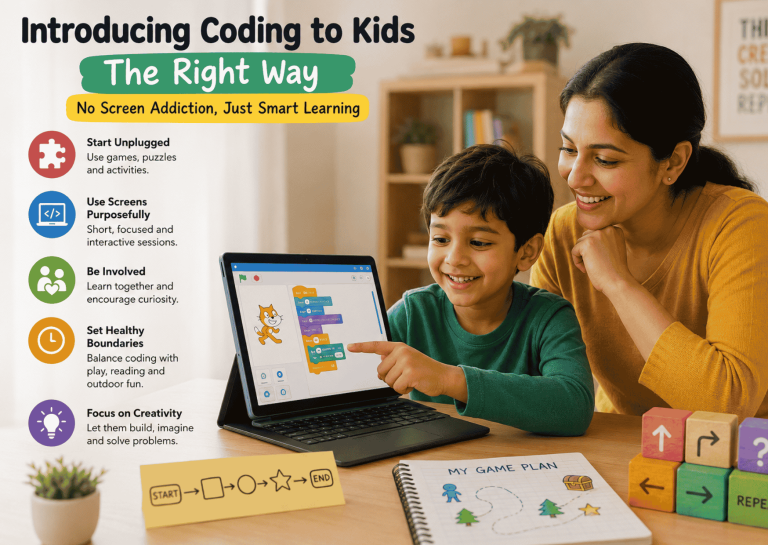
For 6-year-olds:
– short sessions,
– active participation,
– and guided learning…
…are far healthier than passive entertainment.
Experts generally recommend:
– avoiding long continuous sessions,
– balancing physical play,
– and ensuring screens are used for creation, not just consumption.
A child building a simple animation is very different from a child endlessly watching videos.
Best Types of Coding Platforms for Young Kids
At this age, visual coding works best.
Platforms like:
– ScratchJr,
– Blockly,
– and beginner-friendly game builders…
…allow children to:
– drag blocks,
– create stories,
– animate characters,
– and solve puzzles.
This removes typing frustration and keeps learning playful.
The ideal coding class for young children should include:
– interaction,
– creativity,
– storytelling,
– and problem-solving.
Not memorizing syntax. Contact eduSeed for more details.
How to Prevent Screen Addiction While Teaching Coding
Here are practical rules that work for many families:
1. Keep Sessions Short
20–30 minutes is often enough for young kids. Quality matters more than duration.
2. Focus on Creation, Not Consumption
Ask:
– “What did you build today?”
instead of:
– “What did you watch today?”
Creating activates the brain differently.
3. Use Coding as One Part of a Balanced Childhood
Coding should exist alongside:
– outdoor play,
– reading,
– sports,
– art,
– and family time.
Balance is everything.
4. Participate With Your Child
Young children learn best when parents engage with them.
You don’t need coding knowledge.
Just ask:
– “How did you make this work?”
– “What happens if you change that?”
Your interest increases their motivation.
5. Avoid Reward-Based Screen Habits
Don’t use coding apps as:
– digital babysitters,
– or unlimited rewards.
Children should associate technology with learning and creativity — not endless entertainment.
What Parents Should Really Aim For
At age 6, success does not mean:
– mastering Python,
– building complex apps,
– or spending hours online.
Success means your child:
– enjoys solving problems,
– asks curious questions,
– experiments fearlessly,
– and learns to think logically.
That foundation matters far more than early technical expertise.
Because the future won’t belong only to children who can use technology.
It will belong to children who can:
– think creatively,
– solve problems,
– and build ideas confidently.
And coding — when introduced thoughtfully — helps nurture exactly those skills.
Final Thoughts
Coding doesn’t have to compete with a healthy childhood.
In fact, when introduced correctly, it can enhance creativity, curiosity, and confidence.
The secret is simple:
Start small.
Keep it playful.
Prioritize thinking over screens.
For a 6-year-old, coding should feel less like a class…
…and more like an adventure.

Priya Gunasekaran
Priya, a mother of two, understands the value of a strong foundation in Computer Science from an early age. With a keen interest in technology and a passion for researching parenting techniques, she believes that the most effective way for children to retain knowledge is by making learning fun and engaging. Priya, on the other hand, works as a Content Writer at Eduseed, contributing to educational content that supports these goals.