


Harshini
- 15 Jun, 2026
- 0 Comments
- 5 Mins Read
Should Kids Still Learn to Code If AI Can Do It for Them?
[ n Yes, children should still learn to code, even though AI tools can now generate code automatically. The reason is that coding teaches children how to think logically, break down complex problems, and understand how technology works — skills that AI cannot replicate or replace. According to the Raspberry Pi Foundation’s 2025 position paper, even in a world where AI writes code, we still need humans who can critically evaluate, guide, and improve that output. Children who learn to code become better at directing AI, not competing with it. The question is not whether AI can write code. It is whether your child will know how to use, question, and build on what AI produces.
What You’ll Learn In This Article
✅ Why coding is still important in the AI era
✅ How coding develops problem-solving skills
✅ Why AI cannot replace logical thinking
✅ How coding prepares children for future careers
Why This Question Matters
If you have recently read news about artificial intelligence, you may be wondering whether coding is still worth learning. After all, tools like ChatGPT and GitHub Copilot can generate working code in seconds from simple instructions.
This concern is understandable. Many parents are asking whether children should spend time learning a skill that AI seems capable of doing automatically. However, this question often comes from a misunderstanding of what coding actually teaches.
Coding has never been only about typing commands into a computer. It is about learning how to think, solve problems, and create solutions. These skills remain valuable regardless of how advanced AI becomes.

What Coding Actually Teaches Children
1. Logical Decomposition
Logical decomposition is the ability to break a large problem into smaller, manageable steps.
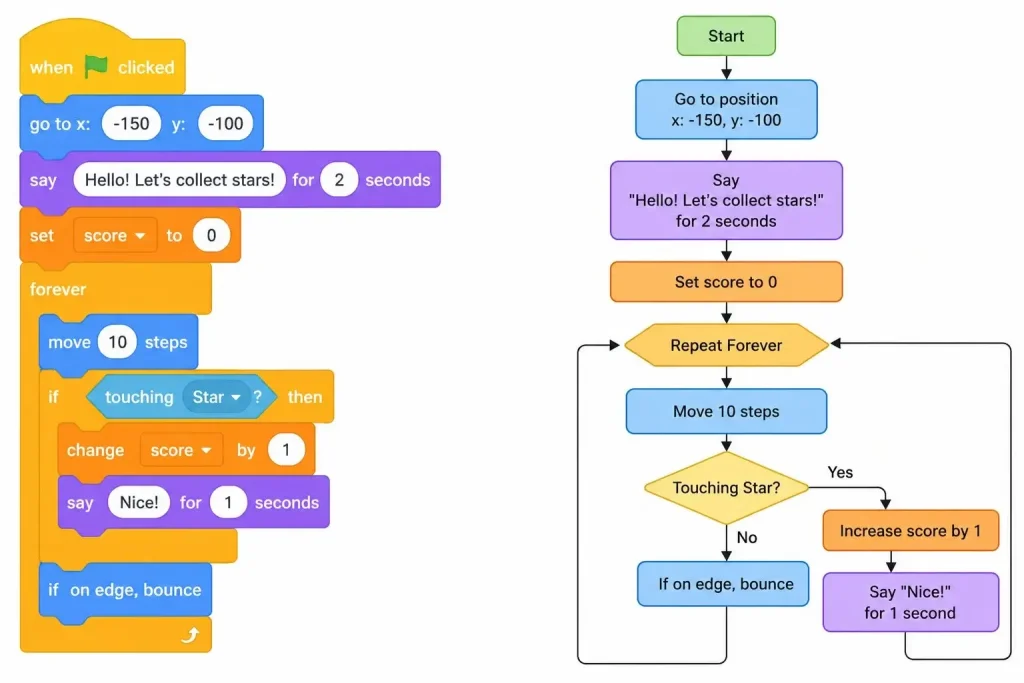
Imagine your child is building a Scratch game. They need to decide what happens when a player jumps, touches an obstacle, or reaches a new level. To make the game work, they must think through each step carefully.
This structured way of thinking helps children solve problems not only in coding but also in maths, science, and everyday life. AI can generate code, but it cannot replace the human ability to define the problem and decide what needs to happen.
2. Debugging and Error Solving
Debugging is the process of finding and fixing mistakes.
When a program does not work correctly, children learn to investigate the problem, test different solutions, and improve their work. This develops patience, persistence, and analytical thinking.
Even AI-generated code contains mistakes. Someone who understands coding can identify those errors and improve the output. A child who learns debugging gains valuable problem-solving skills that extend far beyond computers.
3. Computational Thinking
Computational thinking is understanding how computers process information and make decisions.
Children learn concepts such as loops, conditions, variables, and sequences. These concepts teach them how technology works behind the scenes.
As AI becomes more common, computational thinking becomes even more important. Children who understand these concepts can use AI tools more effectively and evaluate whether the results make sense.
4. Creative Problem Ownership
Coding allows children to build something that did not exist before.
Whether it is a game, animation, website, or mobile app, children experience the satisfaction of creating something through their own ideas and decisions. This builds confidence, creativity, and independence.
Rather than simply consuming technology, children become creators. They learn that technology can be shaped, improved, and controlled by people.
Did You Know?
🌐 India is one of the world’s largest technology talent hubs.
📊 AI-related careers continue to grow rapidly.
🎯 Future jobs will require both AI literacy and problem-solving skills.
Why This Matters Especially for Indian Children
Competitive Exams Still Reward Logical Thinking
Examinations such as JEE, Olympiads, and many CBSE assessments require students to solve problems independently. They test logical reasoning, analytical thinking, and structured problem-solving.
The same thinking skills developed through coding can help children approach complex maths and science questions more effectively.
India’s Future Workforce Needs AI-Literate Thinkers
India continues to be one of the world’s leading technology hubs. The future workforce will not simply rely on AI-generated answers.
Companies will need professionals who can understand systems, review AI-generated solutions, identify mistakes, and make important decisions. Coding education helps build these abilities from an early age.
Schools Often Do Not Teach Practical Coding
While many schools introduce computer science concepts, practical coding opportunities are often limited.
Project-based coding classes allow children to create games, websites, applications, and AI projects. This hands-on experience develops skills that traditional classrooms may not provide.
Without Coding
- Uses AI blindly
- Depends on technology
- Consumes apps
- Follows instructions
With Coding
- Evaluates AI responses
- Understands technology
- Creates apps
- Solves problems
A Simple Analogy: Calculators and Mathematics
When calculators became common, some people believed children would no longer need to learn arithmetic.
That prediction turned out to be wrong. Students still need to understand mathematical concepts to use calculators effectively and verify whether answers are correct.
AI and coding have a similar relationship. AI is like the calculator. Coding knowledge is like arithmetic. Children who understand coding can use AI intelligently, while those who do not may struggle to judge whether AI-generated solutions are accurate.
Frequently Asked Questions
If AI can write code, why should my child learn it?
Coding teaches much more than programming syntax. It develops logical thinking, problem-solving, creativity, and analytical skills that help children use AI effectively and responsibly.
Will coding still be a useful career skill in 10 years?
Yes. The future will require people who can understand technology, review AI output, design systems, and solve complex problems. Coding helps build these essential skills.
Is there any point in starting coding before age 10?
Absolutely. Platforms such as Scratch introduce coding concepts through games and animations. Early exposure helps children develop strong logical thinking skills before moving on to advanced programming languages.
My child already uses ChatGPT. Isn’t that enough?
Using AI is different from understanding it. Coding helps children understand how technology works, identify mistakes, and make informed decisions rather than relying entirely on AI-generated responses.
Does coding help with maths and science?
Yes. Coding strengthens logical reasoning, pattern recognition, sequencing, and analytical thinking. These skills directly support learning in mathematics, science, and other academic subjects.
Final Thoughts
AI is transforming technology, but it is not making coding irrelevant. In fact, coding is becoming more valuable because it teaches children how to think, create, and direct technology rather than simply consume it.
At eduSeed, we help children aged 6–16 learn coding through live, project-based classes in Scratch, Python, Web Development, and AI. Our goal is to build the thinking, creativity, and problem-solving skills that matter in an AI-powered future.
Book a free trial coding class today and discover how your child can become a confident creator of technology, not just a user of it.