


Harshini
- 13 Aug, 2026
- 0 Comments
- 8 Mins Read
Why Is My Child Struggling With Math? 10 Possible Reasons
Does your child understand a math concept one day and forget it the next?
Do they take a long time to complete simple calculations? Do they avoid math homework, feel nervous before a test, or quickly say, “I don’t know” when they see a difficult question?
If this sounds familiar, you are not alone.
Many parents worry when their child starts struggling with math. It is easy to think that the problem is a lack of practice or that the child simply isn’t “good at math.”
But math struggles can happen for many different reasons.
Sometimes a child has missed an important foundational concept. Sometimes they need more visual or hands-on learning. Sometimes word problems are the real challenge. And sometimes, a lack of confidence makes an otherwise manageable problem feel much harder.
The good news is that struggling with math today does not mean your child will always struggle with math.
With the right support, children can strengthen their understanding, improve their problem-solving skills, and gradually become more confident learners.
Let’s look at 10 common reasons why a child may struggle with math.
1. The Math Foundation Isn’t Strong Enough
Think of mathematics like building a house.
Before adding another floor, the foundation needs to be strong.
Math works in much the same way. Children need to understand basic concepts before they can confidently move on to more advanced ones.
For example:
Place value → Addition and subtraction → Multiplication and division → Fractions → Decimals → Percentages
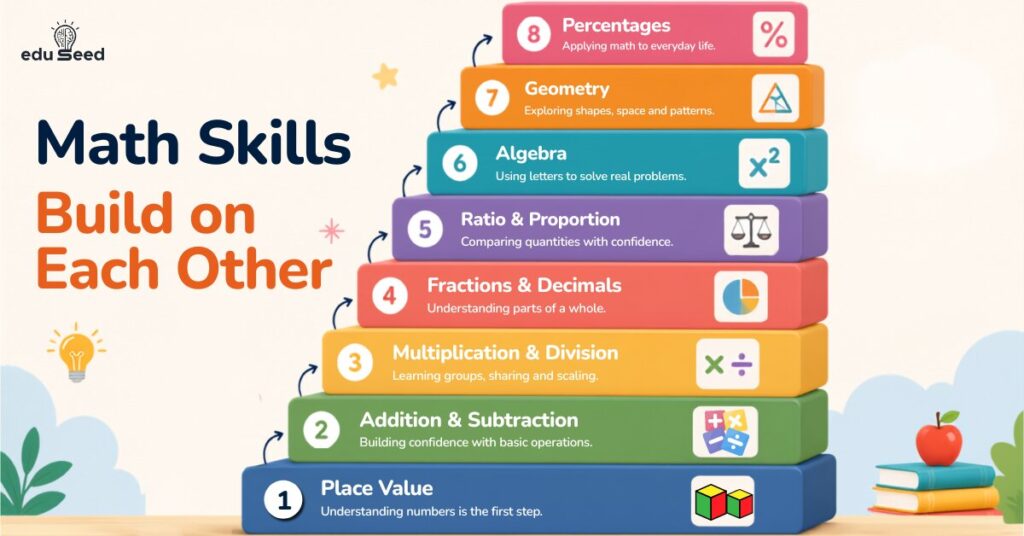
If a child is not comfortable with place value, multiplication, or basic operations, later topics can become confusing.
What might you notice?
Your child may:
- Make the same type of mistake repeatedly
- Forget previously learned concepts
- Take a long time to solve basic calculations
- Struggle when a familiar concept appears in a new form
What can parents do?
Instead of immediately moving to harder questions, take a step back.
Find the exact concept your child is struggling with and strengthen that foundation first.
A strong mathematical foundation can make future learning much easier.
2. Your Child May Be Memorising Instead of Understanding
Sometimes children learn a procedure without understanding why it works.
For example, a child may remember:
6 × 7 = 42
but may struggle when asked:
“Can you show 6 groups of 7?”
or:
“How can you work out 6 × 7 without memorising it?”
This is where conceptual understanding becomes important.
At eduSeed, we believe mathematics should go beyond simply finding the answer. Children need opportunities to understand concepts, identify patterns, reason through problems, and apply what they have learned.
Try asking:
Instead of only asking:
“What is the answer?”
ask:
“How did you get the answer?”
This small change can tell you a lot about your child’s understanding.
3. Your Child May Need a Different Way of Learning
Every child learns differently.
One child may understand a concept immediately from an explanation. Another may need a picture. Someone else may understand it better by using objects or solving a real-life problem.
For example, instead of explaining:
3 × 4 = 12
only using numbers, show your child:
🍎 🍎 🍎 🍎
🍎 🍎 🍎 🍎
🍎 🍎 🍎 🍎
Then explain:
3 groups of 4 = 12
This makes the mathematical idea visible.
The Concrete–Pictorial–Abstract (CPA) approach is one way of gradually moving children from hands-on experiences to pictures and finally to mathematical symbols.
Parents can try:
- Counters
- Coins
- Blocks
- Number lines
- Drawings
- Everyday objects
Sometimes the child doesn’t need more explanation. They need a different explanation.
4. Math Anxiety May Be Making Things Harder
Have you noticed your child becoming nervous as soon as you mention math?
They may say:
“I can’t do this.”
before even trying.
This could be a sign that they have developed a negative association with mathematics.
When children are worried about making mistakes, they may focus more on avoiding failure than on solving the problem.
What can parents do?
Try changing the language around math.
Instead of:
❌ “You should know this already.”
Try:
✅ “Let’s work it out together.”
Instead of:
❌ “This is easy. Why can’t you do it?”
Try:
✅ “Which part is confusing you?”
And instead of celebrating only correct answers, celebrate effort and progress.
“You tried a different method this time. That’s great!”
A supportive environment can help children become more comfortable with mathematical challenges.
5. Your Child May Have Gaps in Number Sense
Number sense is a child’s understanding of numbers and how numbers relate to one another.
It goes beyond simply recognising numbers.
For example, can your child understand:
- Which number is greater?
- How much bigger is 50 than 35?
- What happens when 10 is added to 47?
- Can 24 be split into different groups?
- Which is closer to 100: 92 or 68?
These ideas help children develop flexible mathematical thinking.
Try this simple activity
Give your child two numbers:
48 and 63
Ask:
Which is greater?
Then ask:
“How do you know?”
There isn’t just one way to explain the answer.
Your child might say:
“63 has 6 tens and 48 has only 4 tens.”
That’s mathematical reasoning.
6. Word Problems May Be the Real Problem
Sometimes a child can calculate perfectly but struggles with word problems.
For example, your child may know:
72 − 25 = 47
but become confused by:
“A shop had 72 pencils. It sold 25 pencils. How many pencils are left?”
The difficulty may not be subtraction.
Your child may be struggling to:
- Understand the story
- Identify important information
- Decide which operation to use
- Understand what the question is asking
Try the 3-question method
Teach your child to ask:
What do I know?
What do I need to find?
What operation can help me?
Encourage your child to draw the situation if necessary.
Turning a word problem into a picture can make it much easier to understand.
At eduSeed, we focus on helping children approach word problems through clues, reasoning, and understanding rather than simply rushing to an answer.
7. Your Child May Need More Practice—But Not More Pressure
Practice is important in mathematics.
But there is a difference between useful practice and simply giving children more worksheets.
If a child doesn’t understand multiplication, giving them 100 multiplication questions may not solve the problem.
Instead, try:
Understand → Practise → Apply → Challenge
For example:
Step 1: Understand
Use groups of objects to explain multiplication.
Step 2: Practise
Solve a few multiplication questions.
Step 3: Apply
Use multiplication in a real-life problem.
Step 4: Challenge
Give your child a puzzle that requires them to think differently.
This makes practice more meaningful.
At eduSeed, math learning includes activities and worksheets designed to support both conceptual understanding and practice.
8. Your Child May Be Afraid of Making Mistakes
Some children don’t struggle because they don’t know the answer.
They struggle because they are afraid to try.
You may hear:
“I don’t know.”
even when they probably have an idea.
They may erase their work repeatedly or wait for someone else to tell them what to do.
Change the question
Instead of:
“What’s the answer?”
ask:
“What did you try?”
or:
“What do you think we should do first?”
This encourages your child to explain their thinking.
Remember:
A wrong answer can still show useful thinking.
When children learn that mistakes are part of learning, they become more willing to experiment, reason, and try again.
9. Your Child May Find Multi-Step Problems Difficult
Some mathematical questions require children to remember several pieces of information at once.
For example:
Ravi has 48 stickers. He gives 15 to his friend and then buys 20 more. How many stickers does he have now?
The child needs to:
- Identify the first operation.
- Solve it.
- Remember the result.
- Perform the next operation.
- Give the final answer.
That can feel overwhelming for some children.
Break it down
Instead of solving everything at once:
Step 1: 48 − 15 = 33
Step 2: 33 + 20 = 53
Answer: 53 stickers
Teaching children to break larger problems into smaller steps can make mathematics feel much more manageable.
10. Your Child May Simply Need More Confidence
This is one of the most important things parents sometimes overlook.
A child who believes:
“I am bad at math.”
may stop trying before they have really started.
But mathematical ability can grow with learning, practice, feedback, and the right strategies.
Instead of saying:
❌ “My child is weak in math.”
try saying:
✅ “My child is still building confidence in math.”
That small change in language can make a big difference.
5 Simple Ways to Improve Math Skills at Home
- Make Math Fun
Use puzzles, games, and simple challenges to make learning enjoyable. - Use Everyday Math
Practise math while shopping, cooking, travelling, or telling time. - Ask “How?” and “Why?”
Encourage your child to explain how they found an answer. - Practise a Little Every Day
Short, regular practice is better than long and stressful sessions. - Celebrate Progress
Appreciate effort and improvement, not just correct answers.
When Should Parents Consider Additional Support?
Every child makes mistakes.
One difficult chapter doesn’t necessarily mean that your child has a serious learning problem.
However, if your child consistently struggles with mathematics even after regular practice and support, it may be worth speaking with their teacher.
Pay attention to patterns such as:
- Persistent difficulty with basic number concepts
- Frequent difficulty recalling basic math facts
- Strong avoidance of math
- Extreme frustration during math activities
- Difficulty understanding quantities
- Consistent trouble with calculations
- Difficulty applying a concept in a new situation
The first step is usually to understand exactly where the difficulty is.
Once you know the gap, you can provide more targeted support.
Remember: Your Child Is Not “Bad at Math”
If your child is struggling with math, try not to label them as a “math person” or “not a math person.”
Instead, think about what they need right now.
Maybe they need stronger foundations.
Maybe they need more visual examples.
Maybe they need help understanding word problems.
Maybe they need more practice.
Or maybe they simply need someone to tell them:
“It’s okay if you don’t know it yet. Let’s learn it together.”
Mathematics is not just about getting answers quickly.
It is about understanding, reasoning, finding patterns, solving problems, and learning from mistakes.
At eduSeed, our approach to mathematics focuses on helping children build strong conceptual foundations while developing problem-solving and logical-thinking skills. Our Math Program for Grades 1–8 combines interactive learning, activities, and structured practice to help children become more confident learners.
Final Thought for Parents
The next time your child says:
“I can’t do math.”
don’t immediately correct them.
Try saying:
“You can’t do it yet. Let’s figure it out together.”
Sometimes, that little word—yet—can change the way a child sees learning.
Strong foundations. Curious thinking. Confident problem-solving.
That’s the kind of mathematical journey we want every child to experience.
Explore More Math Learning Resources
Parents can also explore the eduSeed Math Learning Hub for resources covering topics such as place value, operations, fractions, decimals, percentages, factors, multiples, geometry, logical reasoning, and more.
Ready to help your child build stronger math skills?
Explore the eduSeed Math Program and discover a learning approach designed to make mathematics more understandable, engaging, and confidence-building for children.